Category: Education

  • Spring-Up Global Network, Deloitte literacy drive: GES Director-General inaugurates 8th library

    Spring-Up Global Network, Deloitte literacy drive: GES Director-General inaugurates 8th library

    Abtvgh / GES/

    The Spring-Up Global Network (SUGN) in partnership with Deloitte has inaugurated its 8th library at Aburi in the Eastern Region to promote literacy among children.

    The projects, which are funded by Deloitte started in October 2022 with the inauguration of the first library in November in 2022 at the Osu Cluster of Schools in the Greater Accra Region.

    Beneficiary schools

    The projects involve the repurposing of empty classrooms into libraries, which have been refurbished and restocked in eight clusters of schools across five regions. The beneficiary schools are the Osu Cluster of Schools and Kwashieman Cluster of Schools in the Greater Accra; Adweso Cluster of Schools at Koforidua and Aburi Cluster of Schools in the Eastern Region and Achiase Cluster of Schools in the Central Region.

    The rest are the State Experimental Basic School and Konongo Mines M/A Basic School in the Ashanti Region and more recently the Hohoe East Cluster of Schools in the Volta Region.

    In all, a total of 23,319 children have been directly impacted by this innovative and purposeful project.

    Commitment of GES

    Inauguration the Aburi Cluster of Schools library, the Director-General of the Ghana Education Service (GES), Dr Eric Nkansah, pledged the commitment of the service to implement various interventions and initiatives to improve learning outcomes.

    He said the GES was determined, in consistence with its mandate of ensuring that it delivers quality, inclusive, holistic, and relevant education, to achieve improved learning outcomes for the benefit of all Ghanaian children of school-going age without any discrimination.

    “Our work impacts every home; thus, we uphold the values of partnerships and collaboration to ensure we work with all stakeholders to achieve our objectives,” he pointed out.
    He applauded Deloitte and SUGN for playing a significant role in transforming the educational landscape.

    Through their diligent efforts and work with us, I am pleased to learn that within 20 months, the Deloitte WorldClass Initiative has provided eight libraries with over 9,400 books and impacted over 23,000 learners across five regions in Ghana,” he said. 

    Dr Nkansah expressed confidence that the libraries would empower the students to broaden their horizons, deepen their understanding of diverse subjects, and cultivate critical thinking skills essential to succeed in the 21st century.

    He assured Deloitte and Spring-Up Global that the schools would uphold the highest level of maintenance to preserve the libraries for generations, adding, “This facility will change this district for the good!”

    Shared goals

    The Executive Director of SUGN, Akorfa Ama Akoto, said the partnership between Deloitte and her outfit had not only brought them closer to their shared goal of promoting literacy but also made a significant impact on the lives of thousands of children in Ghana, “a testament to our collective efforts”.

    She said the inauguration of the 8th library increased “our impact to 23,319 learners in our first year of implementation. This means that more children are benefiting from the initiative than the initial target of 16,000 for all eight libraries in the first year. 

    “On behalf of the entire SUGN team, I want to commend Deloitte for funding this project and continuously supporting the SUGN Project team to achieve this feat,” Ms Akoto said.

    She applauded the GES, for giving all the support needed to achieve and exceed the target of the initiative, adding, “To the learners who are the reason for this project, we thank you for making the best use of the libraries”. 

    For his part, the Country Managing Partner of Deloitte Ghana, Daniel Kwadwo Owusu, said the library project was important to the firm’s community initiative of ‘Making Impact that Matters’ and aligned with the UN Sustainable Development Goal Four (SDG4), which simply promoted quality education.

    Aligned with Deloitte’s WorldClass initiative, Mr Owusu said Deloitte had been committed to creating better futures for the next generation and making a posi

  • Presbyterian University to set up $1M AI lab

    Presbyterian University to set up $1M AI lab

    Abtvgh/ Presbyterian/

    The Presbyterian University, Ghana (PUG) has begun processes to establish an artificial intelligence (AI) laboratory to enhance teaching and learning of information and communications technology (ICT).

    The $1 million project is to be sponsored and constructed by Virtual Security Africa, a company in the ICT space, under the auspices of the Presbyterian Church of Ghana (PCG).

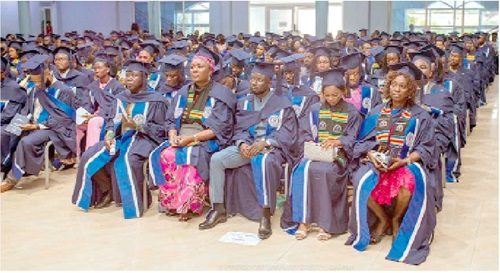
    The Moderator of the PCG and Chancellor of the University, Rt Rev. Dr Nana Opare Kwakye, made this known at the sixth congregation of the School of Graduate Studies of the Presbyterian University at the main campus of the university at Abetifi in Kwahu East District in the Eastern Region.

    A total of 341 postgraduate students made up of 224 males and 117 females graduated with Masters degrees in Management, Public Health, Educational Studies and Natural Resources.

    Rt Rev. Dr Kwakye gave an assurance that the PCG was keen to see the development of the university on all fronts.  “At the last graduation ceremony, my predecessor instituted a scholarship for the university with personal seed money. After my speech today, I am adding on to that,” he stated.

    The Moderator urged graduates to take advantage of opportunities in the country to make the most out of their education. 

    Elections

    As the general elections approach, the Moderator urged Ghanaians not to be swayed by empty promises or divisive rhetoric. The Vice-Chancellor of the University, Professor John Ofosu Anim, stated that a graduate degree was not only about the acquisition of knowledge, but also a duty to apply that knowledge ethically and for the betterment of society.

    The congregation 

    He said the world today faced complex challenges, be it social, economic or environmental, and, therefore, challenged the graduates to use their skills and expertise to confront the challenges head-on.

  • Crisis-hit as Nigerian university students are ordered to leave UK

    Crisis-hit as Nigerian university students are ordered to leave UK

    Abtvgh / BBC

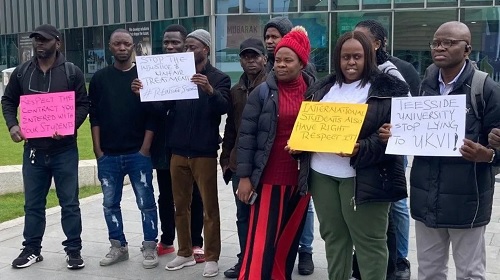
    Nigerian students have been thrown off university courses and ordered to leave the UK after a currency crisis left them struggling to pay tuition fees on time.

    Teesside University students were blocked from their studies and reported to the Home Office after the value of Nigeria’s naira plummeted, wiping out their savings.

    Some told the BBC they felt suicidal as they accused the university of taking a “heartless” approach to those who fell into arrears as a consequence.

    A university spokesman said failure to pay was a breach of visa sponsorship requirements, and that it had “no choice” but to alert the Home Office. The Home Office said visa sponsorship decisions rested with the institution.

    Nigeria is currently experiencing its worst economic crisis in a generation, which is having a significant impact on Nigerian students at some UK universities.

    The annual inflation rate is now almost 34%, partly driven by President Bola Tinubu’s dropping of a fuel subsidy last year that put up petrol and diesel prices and which has filtered through into the cost of other goods.

    The government has also stopped trying to support the value of the naira on the currency market and it has depreciated in the past 12 months by more than 200% against the dollar.

    Before beginning their studies at Teesside, affected students were told they had to show proof of having enough funds to pay tuition fees and living expenses.

    However, those funds were significantly depleted as a result of the crisis in their home country.

    This exacerbated financial problems already being experienced by students as a result of the university changing tuition fee payment plans from seven instalments to three.

    A group of students, 60 of whom shared their names with the BBC, began pressing the university for support after a number of people who defaulted on payments were frozen out of university accounts and involuntarily withdrawn from their courses.

    Some were reportedly also contacted by debt collection agencies contracted by the university.