The viral social media conversation between GHOne TV’s Star Girl Serwaa Amihere and Rich Accra Boy Henry Fitz still has been a topic of great interest for Ghanaians on the internet.
Henry Fitz has once again dropped a piece of profound details regarding the viral video that captures him and Serwaa Amihere in a cosy position on a bed allegedly after several rounds of ‘bedmatics’.
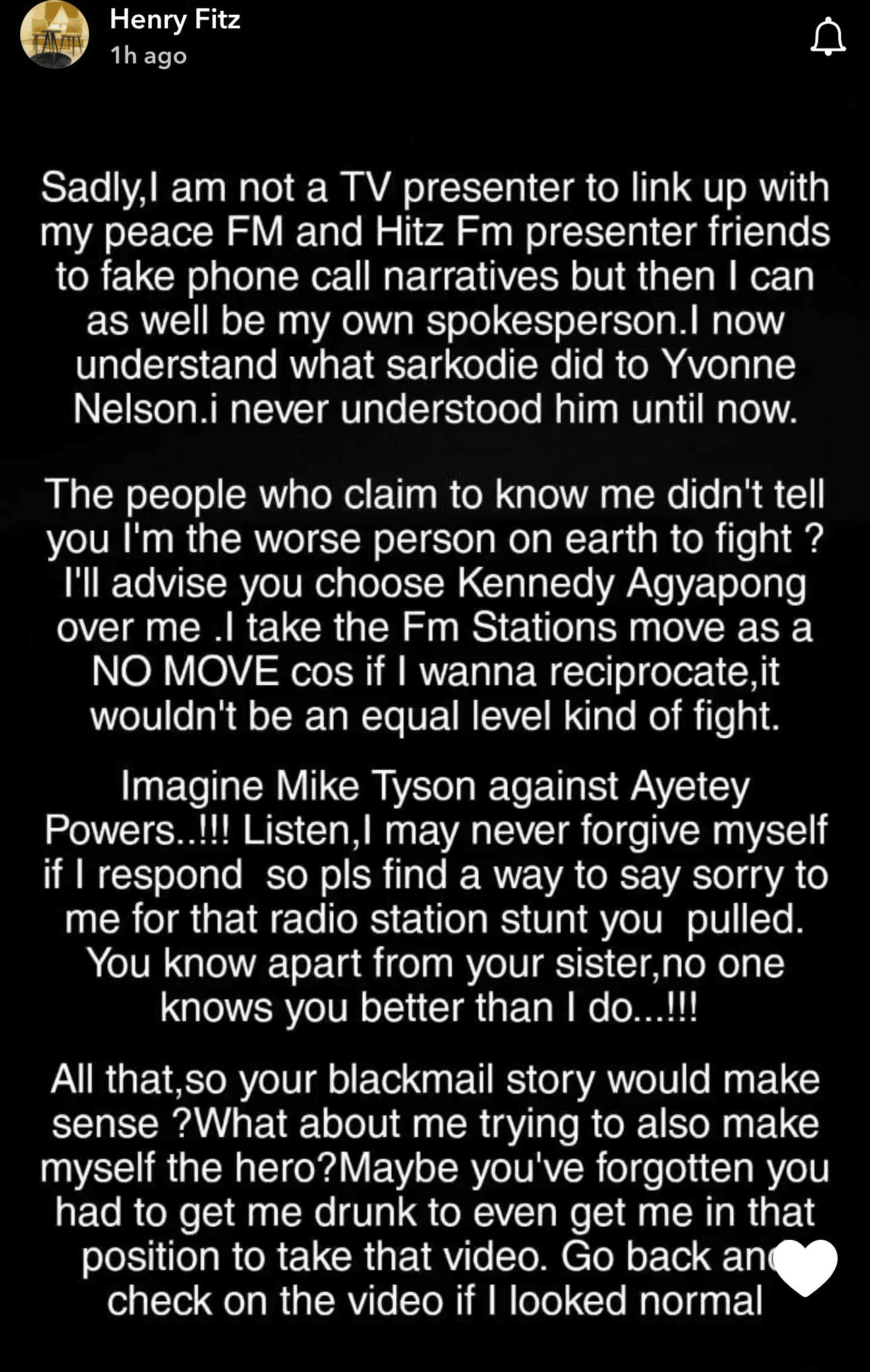
In his most recent post on social media (his Snapchat), Henry vehemently claims that the broadcast journalist got him drunk so that she could sleep with him and record him to blackmail him.
Henry explained that Serwaa Amihere after getting him drunk put him in that position as seen in the video because he was helpless and was under the influence of alcohol.
The embattled Henry Fitz further mentioned in his writings that Serwaa Amihere is using the radio and TV to make him look bad and trying her possible best to use that arsenal to rubbish his statements.
Again Henry established that he demands Amihere to say SORRY to him so that they settle score and finally call a truce adding that he could be more dangerous in his dealings should he try to go wider on this issue.
A Nigerian lady currently based in the UK has shared a shocking story on X formerly Twitter which has left many users on the microblogging platform jaw-dropped.
According to the lady with the handle @ShirlenRay, she got back from work one day and feeling exhausted, she just undressed and slept on her couch.
Her cat crawled toward her and some minutes later, he hopped on her. Initially, she assumed the cat just wanted to play but the pet had its intentions.
As claimed by the lady, the cat inserted its genitalia into her V. She wanted to push it away but the surreal feeling she experienced within that period made her moan and scream at the same time.
The cat kept stroking her until they both climaxed.
The next morning, the cat came again for them to have intercourse.
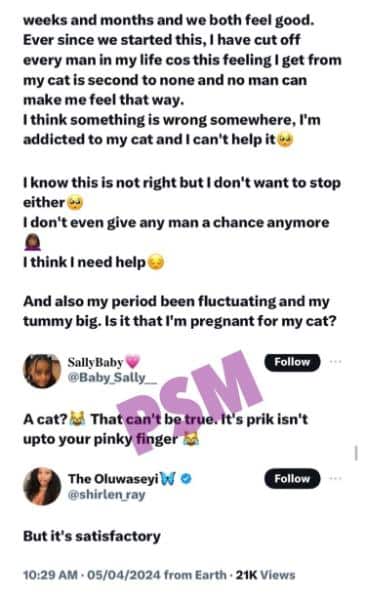
In her words, ever since she fell in love with the cat, she has completely cut ties with men.
Now, her period is fluctuating and her tummy has also grown big hence she suspects she has taken seed for the cat.
Take a look at the screenshots below to know more…
Serwaa Amihere and her alleged ex-lover, Henry Fitz, have been trending on social media for the past 4 days and clearly, the verbal attacks on them aren’t ending anytime soon.
Recall that before the leak of the intimate moment between Serwaa Amihere and Henry Fitz on social media, Abena Korkor had alleged that both the TV presnter and her Godmother were heavyweights in the ashawobrity industry.
Initially, Ghanaians slammed Abena Korkor and pointed out her deteriorated mental health as the cause of her baseless talks but she has now been vindicated.
Reacting to the viral video which is on the phone of almost every Ghanaian, Abena Korkor has alleged in a trending audio that she and Serwaa some men who are in a class of their own in various industries have had intercourse with the two of them before.
As asserted by Abena, one big man in the banking industry has slept with her and Serwaa.
Cementing her claims, Abena Korkor shared a story of how the man named Bernard Osei Tutu dropped her at Studio 7 saloon and Serwaa went behind her back to ask if the man had anything to do with her.
In Abena Korkor’s words, Bernard Osei Tutu once told her that almost all the guys in Accra have slept with her
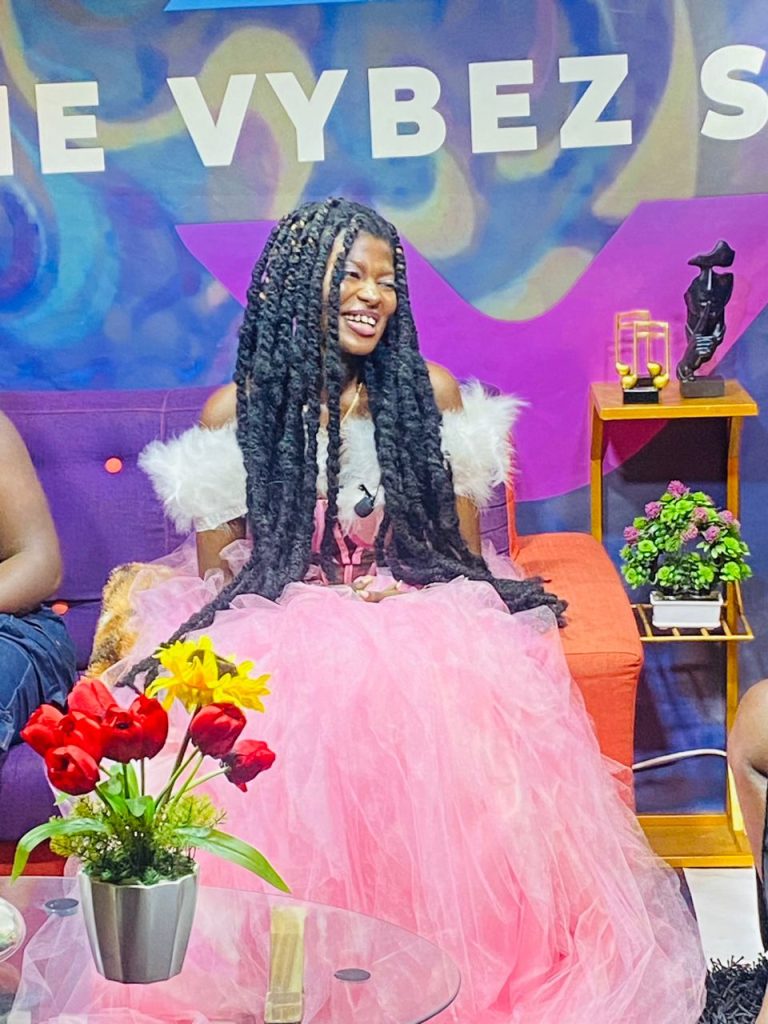
Following her impressive debut year in the showbiz industry, talented singer, Sally M, known by her birth name as Sally Mugabe Hayfron has been adjudged as the New Artist of the Year at the 2023 Western Music Awards.
This forms part of Sally M’s incredible performance in her debut campaign in the showbiz industry.
Sally M featured Ahkan, formerly part of the vibrant Ruff and Smooth fame on her popular tune Feeling which is among the five most streamed songs of Artists from the Western Region concerning Lasmid, Kofi Kinaata, Fameye and Dope Nation in the year considered.
Sally M surpassed competition from; Fiffi Latex, Phynex, and Debby Sway among others in the New Artist of the Year category.
She was nominated for the Highlife Song of the Year category for her single Makoma.
In an unprecedented year where all three of her songs; Attention Love, Makoma and Feeling earned massive rotations and growth on the digital streaming platforms she’s recognized for such a feat.
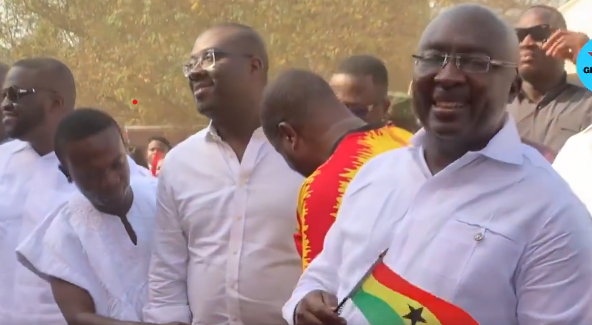
Vice President, Dr Mahamudu Bawumia has urged Ghanaians to support Afua Asantewaa Aduonum, the Ghanaian singer attempting to break the longest singing marathon by an individual.
In an interview with Citi News after visiting the Akwaaba Village in Accra on Monday to support Afua Asantewaa, the NPP Flagbearer indicated that he had followed her and was amazed by her performance.
“What Afua is trying to do is to break a world record and it is not very easy to do. So on a day like Christmas day [when] everybody is spending time with their families. It could be very lonely and I think that as Ghanaians we should give her all the support and encouragement we can.
“I think we should give her all the support so I thought I should stop by here and let her know that Ghana is behind her and she should go ahead and break the record.”
“I have been following and I think that she is doing great. I think that Wednesday we will be back here, we will be back here to break the record,” he stated.
Dr Bawumia was accompanied by the CEO of Ghana Lotteries Authority, Sammy Awuku, Youth Organiser of the NPP Salam Mustapha and other NPP bigwigs.
Afua Asantewaa kicked off her attempt to break the record for the longest individual singing marathon at Akwaaba Village at the airport.
The Ghanaian singer is expected to break the longest singing marathon by an individual which lasted 102 hours. The record is held by Indian Sunil Waghmare, who earned the milestone after singing for 105 hours from March 3 to March 7, 2012.
In a nearly five-day event that started exactly at midnight from Sunday, December 24 to December 27, 2023, she began with OSIBISA’s ‘WOYAYA’ and followed with two gospel songs.
After a nonstop 4-hour performance, she took a 20-minute break to change her costume and then resumed. Miss Asantewaa will be singing only Ghanaian songs throughout her record-breaking attempt. She has so far done 24 hours of non-stop singing.
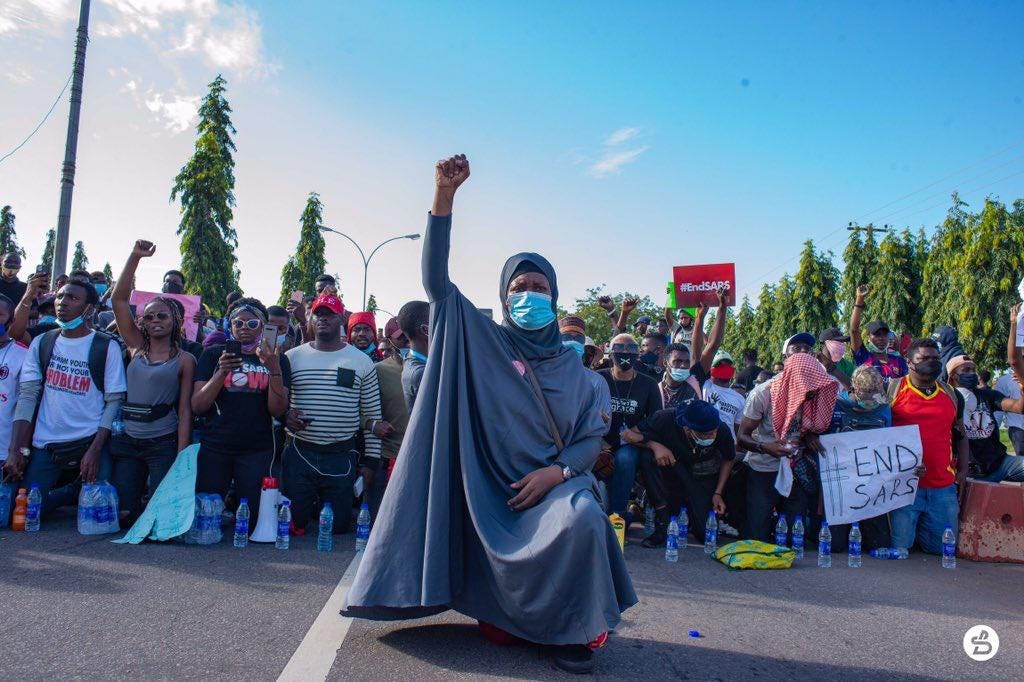
December 10 each year is observed as Human Rights Day globally, and the theme for this year is, “Dignity, Freedom, and Justice for All”, which incidentally resonates with the national motto – “Freedom and Justice”.
The day was established 75 years ago, when the UN General Assembly adopted the Universal Declaration of Human Rights (UDHR).
Thus, this year’s Human Rights Day presents the opportunity for the world to take stock of the UDHR, 75 years after its adoption.
The UDHR is a milestone document which proclaims the inalienable rights that everyone is entitled to as a human being – regardless of race, colour, religion, sex, language, political or other opinion, national or social origin; property, birth or other status.
In the decades after the adoption of the UDHR in 1948, human rights have become more recognised and more guaranteed across the globe.
They have since served as the foundation for an expanding system of human rights protection which focuses also on vulnerable groups such as persons with disability, indigenous peoples and migrants today.
However, the promise of the UDHR, of dignity and equality in rights, has been under sustained assault in recent years.
As the world faces new and ongoing challenges — pandemics, conflicts, exploding inequalities, a morally bankrupt global financial system, racism, climate change — the values and rights enshrined in the UDHR provide guideposts for our collective actions that do not leave anyone behind.
Human rights are the basic rights and freedoms that belong to every person in the world, from birth until death.
They apply regardless of where one hails from, what one believes in or how one chooses to live his or her life.
These rights can never be taken away, although they can sometimes be restricted – for example, if a person breaks the law, or in the interest of national security or public good.
These basic rights are based on shared values such as dignity, fairness, equality, respect and independence, and are defined and protected by law.
Human rights include the right to life and liberty, freedom from slavery and torture, freedom of opinion and expression, the right to work and to education, and many more which are very important for the preservation of life, humanity and humanness.
These are the checks that ensure we continue to live as human beings, as we all have animalistic tendencies that we need to deliberately subdue at all times to maintain the distinction between us and animals in the wild.
All the basic human rights find expression in the 1992 Constitution, specifically in Chapter Five under Fundamental Human Rights and Freedoms and every citizen needs to acquaint him or herself with this provision, to ensure that our human rights are never trampled upon.
Much as the issue of human rights has often been abused, even when common sense is needed in some instances, just because people want to have their way, we must guard the sanctity of humanity, by making sure our basic rights as humans are not abused by others.
It is the duty of every country to promote and protect the fundamental human rights and freedoms of its individuals regardless of their political, economic and cultural background.
We, therefore, urge all stakeholders to create an environment that enables individuals to speak against human rights abuses.
Ghana as a nation needs to do more to protect the rights of the poor, vulnerable and marginalised, including women and children, older persons and persons living with disability.
Some other rights enshrined in the UDHR are the business operations and environmental rights which companies and organizations must respect.
The corporate responsibility to respect human rights requires companies to put in place human rights due diligence in order to identify, address and mitigate human rights impacts that may occur in their businesses.
It is important for companies to establish an effective and efficient remedy that apologises, restitutes and compensates for the abuse of the human rights of people through their operations.
We owe it to ourselves to ensure everyone is treated with dignity and freedom that do not impinge on others’ freedoms and champion justice for all.
We should always bear in mind that one’s freedom ends where another’s begins.
Ghana is one of many African countries without a workable long-term national development plan to guide policy formulation and implementation for a minimum of 40 years.
Successive administrations have resorted to piecemeal policies, mostly captured in their party manifestos, to govern the country.
This has given rise to policy inconsistencies, haphazard and abandoned programmes and projects, and the lack of a national vision to guide investors and development agents in decision-making.
As they entrench and exploit the void, our political leaders over the years have tended to pursue and implement what can win elections, not what will develop the country sustainably.
A Professor of Finance and Afreximbank Research Fellow, Joshua Yindenaba Abor, said that needed to stop, given the negative effects on national development and cohesion.
The former Dean of the University of Ghana Business School (UGBS) said the nation needed a long-term development plan to serve as a blueprint for successive governments to draw their plans from.
Delivering a lecture in Accra on the changing roles of national development banks in Africa, the financial economist said the long-term national development plan must be forward-looking by a minimum of 40 years and respected and utilised by all future governments within that time frame.
The Daily Graphic agrees with Prof. Abor and believes that now is the time to start a national conversation on how to develop an all-inclusive national development plan.
We are confounded by the absence of a workable long-term national development plan in spite of the existence of the National Development Planning Commission (NDPC), a constitutionally created agency that is funded by the taxpayer to “advise the President on development planning policy and strategy” and “make proposals on multi-year rolling plans.”
Since its establishment, the NDPC has prepared three long-term development plans – Ghana Vision 2020 (1996-2020), the Seven-Year Development Plan (2009-2015), and the 40-Year Development Plan (2018-2057) that have largely been underutilised.
Just like the rest, the most recent one, the 40-Year Development Plan, with a vision of achieving “a just, free and prosperous society”, has been shelved while manifestos have become the source of policies and programmes.
This harms the economy and the citizens in many ways.
As the International Monetary Fund stated in its policy paper, ‘Navigating Fiscal Challenges in Sub-Saharan Africa : Resilient Strategies and Credible Anchors in Turbulent Waters’, fiscal policy in most sub-Saharan African countries focuses excessively on short-term goals and is not guided by a clear medium-term strategy.
“This lack of anchoring has resulted in frequent breaches of fiscal rules and ever-increasing public debt levels,” the paper published last September said.
These fiscal breaches, which are rampant in Ghana, result from each administration coming with its own programmes, which it moves heaven and earth to implement in order to win votes.
This leads to wastage, fuels lack of accountability and corruption, and polarises the nation further.
Beyond their economic benefits, long-term development plans promote social cohesion and accountable governance.
They serve as a national vision that the citizens unite around to accomplish.
They also make it easier for the populace to track progress and make informed decisions.
With the country battling to overcome one of its worst economic crises in a generation, the Daily Graphic believes now is the time to resurrect a national conversation on an inclusive long-term development plan.
Indeed, as the 2024 election campaigns begin, it will be a good starting point for either of the two leading political parties to agree to support the winner to develop and implement a long-term national development plan that will be respected by all governments.
The paper is aware of the 40-Year Development Plan (2018-2057) developed by the National Democratic Congress and the Ghana@100 Plan developed by the governing New Patriotic Party and believes that those documents could be fused to produce a single plan to serve as the Ghana Vision over the next 40 years or more.
With our nation highly polarised on party and other lines amid an economic recovery, the time is now to harness our collective potential.
A workable national development plan is the best starting point, and now is the time.
Ghana is one of many African countries without a workable long-term national development plan to guide policy formulation and implementation for a minimum of 40 years.
Successive administrations have resorted to piecemeal policies, mostly captured in their party manifestos, to govern the country.
This has given rise to policy inconsistencies, haphazard and abandoned programmes and projects, and the lack of a national vision to guide investors and development agents in decision-making.
As they entrench and exploit the void, our political leaders over the years have tended to pursue and implement what can win elections, not what will develop the country sustainably.
A Professor of Finance and Afreximbank Research Fellow, Joshua Yindenaba Abor, said that needed to stop, given the negative effects on national development and cohesion.
The former Dean of the University of Ghana Business School (UGBS) said the nation needed a long-term development plan to serve as a blueprint for successive governments to draw their plans from.
Delivering a lecture in Accra on the changing roles of national development banks in Africa, the financial economist said the long-term national development plan must be forward-looking by a minimum of 40 years and respected and utilised by all future governments within that time frame.
The Abtvgh agrees with Prof. Abor and believes that now is the time to start a national conversation on how to develop an all-inclusive national development plan.
We are confounded by the absence of a workable long-term national development plan in spite of the existence of the National Development Planning Commission (NDPC), a constitutionally created agency that is funded by the taxpayer to “advise the President on development planning policy and strategy” and “make proposals on multi-year rolling plans.”
Since its establishment, the NDPC has prepared three long-term development plans – Ghana Vision 2020 (1996-2020), the Seven-Year Development Plan (2009-2015), and the 40-Year Development Plan (2018-2057) that have largely been underutilised.
Just like the rest, the most recent one, the 40-Year Development Plan, with a vision of achieving “a just, free and prosperous society”, has been shelved while manifestos have become the source of policies and programmes.
This harms the economy and the citizens in many ways.
As the International Monetary Fund stated in its policy paper, ‘Navigating Fiscal Challenges in Sub-Saharan Africa : Resilient Strategies and Credible Anchors in Turbulent Waters’, fiscal policy in most sub-Saharan African countries focuses excessively on short-term goals and is not guided by a clear medium-term strategy.
“This lack of anchoring has resulted in frequent breaches of fiscal rules and ever-increasing public debt levels,” the paper published last September said.
These fiscal breaches, which are rampant in Ghana, result from each administration coming with its own programmes, which it moves heaven and earth to implement in order to win votes.
This leads to wastage, fuels lack of accountability and corruption, and polarises the nation further.
Beyond their economic benefits, long-term development plans promote social cohesion and accountable governance.
They serve as a national vision that the citizens unite around to accomplish.
They also make it easier for the populace to track progress and make informed decisions.
With the country battling to overcome one of its worst economic crises in a generation, the Daily Graphic believes now is the time to resurrect a national conversation on an inclusive long-term development plan.
Indeed, as the 2024 election campaigns begin, it will be a good starting point for either of the two leading political parties to agree to support the winner to develop and implement a long-term national development plan that will be respected by all governments.
The paper is aware of the 40-Year Development Plan (2018-2057) developed by the National Democratic Congress and the Ghana@100 Plan developed by the governing New Patriotic Party and believes that those documents could be fused to produce a single plan to serve as the Ghana Vision over the next 40 years or more.
With our nation highly polarised on party and other lines amid an economic recovery, the time is now to harness our collective potential.
A workable national development plan is the best starting point, and now is the time.
A careful observation of global developments reveals a rise in resource nationalism where countries are bent on leveraging their resources to promote their national interest.
Specifically, there is a new shift in the geopolitical landscape in the context of the energy transition that is leading to a rise in resource nationalism.
For instance, there is now a resource competition between the United States and European Union on the one hand and China on the other due to the latter’s domination of the supply chains of critical minerals crucial to the energy transition.
Also, there is a new protectionism emerging within Africa with some governments positioning themselves to gain a fair share of resources through an export ban on raw mineral ores without adding value locally.
This is consistent with the African Mining Vision’s key tenet of domestic value addition to minerals before exporting.
Another positive development is the decision by African governments to participate meaningfully in the ownership of the mines through various schemes, including free carried interest.
In the light of these developments, the Daily Graphic views the decision by Ghana’s Mineral Income Investment Fund (MIIF) to take an equity position in Atlantic Lithium as a laudable step and even more should be done in this regard.
Consequently, we are also delighted that our nationals are increasingly taking the risk to invest in mineral exploration and project development. More should be done by the government to encourage these exciting developments.
In this regard, the Abtvgh believes that more targeted and favourable incentives must be offered to Ghanaians who venture into this highly risky industry.
This is more than a moral imperative.
The argument that needs to be made for empowering Ghanaians to be active participants in the mining industry is that it is the surest way to grow the much needed economic linkages from the mining industry.
The Abtvgh is a strong advocate for economic empowerment of Ghanaians in our mining and by extension, the extractive industry.
Such deliberate and strategic endeavour will prevent the repetition of the terrible mistakes we made as a nation in the past in the development of our natural resources.
It is in this vein that we associate with the call by the former Chief Executive Officer (CEO) of AngloGold Ashanti and statesman, Sir Sam Jonah, for the government to provide incentives that would encourage more Ghanaians to venture into mining.
At the recently held 15th Congregation of the University of Mines and Technology (UMaT), he said after many decades of mining, it was a blot on the nation that there was no significant ownership in the big mining firms in the country.
Sir Sam, who is currently the Executive Chairman of Jonah Capital, said empowering Ghanaians to be more involved in mining was the best way to ensure that the country derived the maximum benefits from such natural resources.
“I have consistently bemoaned the absence of a meaningful ownership stake in the ownership of our mines.
Sixty-six years after independence, sadly the situation has not changed much.”
That said, it is instructive to note that there has been a recent encouraging development.
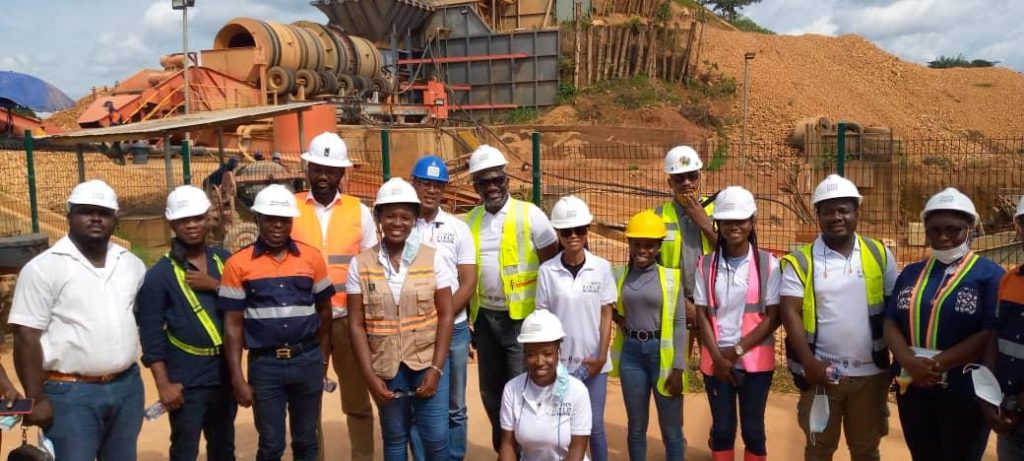
The acquisition of the Azuma project by Engineers and Planners, arguably the most dynamic Ghanaian company on the current mining scene, is undoubtedly one of the most exciting developments in our industry.
We should all encourage more of such initiatives.
As we do that, the state must find ingenious ways to actually encourage and incentivise Ghanaians to own a substantial stake or 100 per cent stake in some of our big mines.
It is important that we begin to think about how to stop eating the crumbs and sit at the table to partake in the meal.
We need to start implementing strategic initiatives to empower our people economically to change the sad narrative of ownership of the mines.
After 30 years of practising democracy under the 1992 Constitution which has witnessed successful elections and changeover of governments from a ruling party to an opposition party, Ghana is seen as one of the shining stars of democracy globally.
The success story of Ghana’s democracy can be attributed to all Ghanaians as well as institutions and the executive, the legislature and the judiciary.
The Abtvgh holds the view that our arms of government must be supported to deliver on their mandate so as to entrench democratic governance, with each arm acting independently of the other.
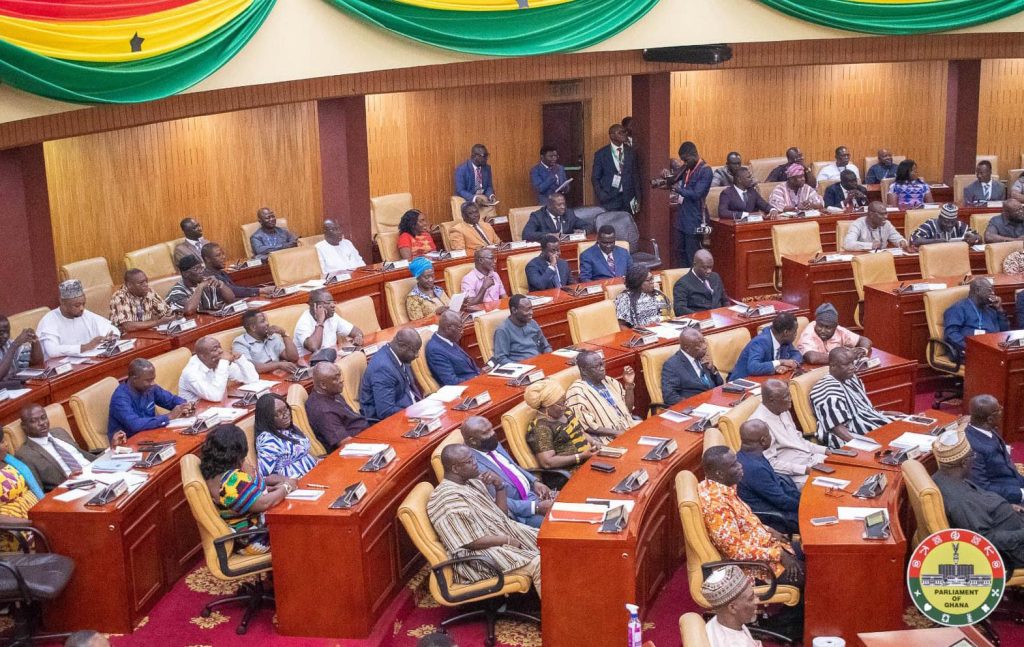
Last week, the Speaker of Parliament, Alban Sumana Kingsford Bagbin, at the Speaker’s Breakfast Forum, called on the executive arm of government to invest in facilities and physical infrastructure of Parliament to enhance its work and preserve the gains chalked up under our democracy.
Many Ghanaians may not be aware that most of the facilities currently being used by Parliament are the property of the Ministry of Foreign Affairs and Regional Integration and managed by the State House.
It is in this light that we find Parliament struggling to hold on to its lands very disturbing. (See November 21, 2023 issue of the Daily Graphic).
The Abtvgh, therefore, calls on the government to take the requisite steps to support Parliament to secure permanent structures to enhance its work in promoting good governance.
This is critical because we believe Parliament can respond better to issues of accountability, play its oversight role effectively, make good laws and attend to its other functions.
Since assuming office as the Speaker of Parliament, Mr Bagbin has introduced some new changes in the administrative set-up of Parliament to make the legislative arm serve the people better.
Reference can be made to the breaking down of its Public Affairs Department into three — media relations, public engagement and television; the Department on Citizens Bureau to engage the public, CSOs and think thanks, among other innovations.
It is worthy of mention that the new Standing Orders which are in the works will soon be introduced.
In view of the demands placed on Parliament and the weight of responsibility imposed on it, it is imperative that the House gets bigger and well-equipped committee rooms because the sittings will be open to the public and the media.
At least the current hung Parliament has proved to some extent that if we empower our Parliament, the era of rushing bills through Parliament or approval of loan agreements will be a thing of the past.
The current Parliament has also demonstrated its deliberative function where issues of national importance and public concerns have come to the floor for discussion and action.
The Daily Abtvgh is of the view that ensuring that the institution of Parliament and the parliamentarians are well resourced not only in the House, but in the constituencies, would enhance their work collectively.
In the constituencies, for instance, an official office for the parliamentarian will facilitate his or her work as constituents would have easy access to him or her.
The Abtvgh urges all those who believe in and support democratic governance to heed the plea of the Speaker and support the provision of these facilities, especially the constituency offices.
That will certainly serve as an avenue for more engagement with the constituents and foster transparency and accountable governance.
After over three decades of uninterrupted parliamentary democracy, we must contribute to making the constituents benefit from the work of Parliament not only during electioneering, but at all times.
We cannot reduce the relationship between MPs and the constituents to doling out of gifts or cash for votes; it must be one of collaboration to address national challenges.