Oil major Shell will divest its majority shareholding from a local South African downstream unit after a comprehensive review of its businesses across all regions, it said on Monday
reuters.com / International News /
“As a result of this review, Shell has decided to reshape the downstream portfolio and intends to divest our shareholding in SDSA … this decision was not taken lightly,” a Shell statement said. It did not specify when the decision took effect.
Shell Downstream SA (SDSA) was formed after Shell South Africa and black empowerment company, Thebe Investment Corporation, agreed a decade ago to merge Shell South Africa Marketing and Shell South Refining businesses. Thebe held a 28% equity stake.
Shell, which has been present in South Africa for more than century, is still exploring the country’s offshore, incurring opposition from environmental campaigners who have launched court action.
During the divestment process, Shell said on Monday it would work to preserve SDSA’s operating capabilities and maintain its brand presence.
A Thebe spokesperson was not immediately available for comment.
One of SDSA’s main assets and South Africa’s largest refinery, Sapref, in the east coast port city of Durban has not been operating since 2022 when Shell and its refinery joint venture partner, BP, decided on a spending freeze and halt to the refinery’s operations.
Flooding along the coast that killed nearly 400 people that same year severely damaged the plant, which at that stage provided around 35% of South Africa’s refining capacity.
South Africa’s Central Energy Fund said two years ago it was interested in Sapref, which has a nameplate capacity of 180,000 barrels per day, as it seeks to overcome energy security concerns.
On Monday, an energy official, speaking on condition of anonymity, said CEF had signed a non disclosure agreement with the parties involved and therefore could not comment.
South Africa is a net importer of refined petroleum products, a challenge exacerbated since the closure of Sapref and the country’s second largest refinery Enref, also in Durban.
The Ministry of Foreign Affairs and Regional Integration last week announced that more than 30,000 uncollected passports are gathering dust at the various passport application centres across the country.
At the Accra and the Kumasi Passport Application centres (PACs) alone, 30,000 passports, processed and issued in the names of individuals, are yet to be collected by the holders.
That was in spite of text messages sent to the owners of the passports alerting them to visit the PACs for collection, according to the ministry.
It has, therefore, called on applicants who applied for passports over the past years to collect them from their respective PACs.
The Abtvgh supports the call by the ministry to applicants to collect their passports as soon as possible.
We find the non-collection of passports worrying, in view of the fact that it costs far more to print passports than the fees charged individuals who need the passports.
For us, the refusal by applicants to collect their passports from the designated points must not be treated lightly.
The paper would want to push for some punitive action by way of penalties levied on the recalcitrant applicants to serve as a warning to them and all those who intend doing same.
This practice must not be treated with kid gloves because of the financial impact on the economy, particularly at a time when every pesewa counts.
We are aware that the ministry has asked individuals awaiting the issuance of their passports to call its Client Service Unit to confirm the status of their passports.
This is refreshing, but these applicants must be urged to pick the passports once they are ready.
The paper finds it refreshing that passport issuance in the country has seen significant improvement in recent years.
The government, we are told, has made the process more efficient and streamlined, making it easier for citizens to obtain the necessary documents.
This is especially important for those living in rural areas, who often face greater difficulty accessing government services.
The paper has also learnt that the government has implemented a number of measures to simplify the passport application process.
For instance, the introduction of e-passports has enabled citizens to apply for their documents online, negating the need to visit a physical office.
This has made passport acquisition easier and much more convenient and accessible.
Additionally, the government has increased the number of PACs throughout the country, providing citizens with more options.
By way of security, the government has taken steps to ensure the safety and security of Ghanaian passport holders.
The introduction of biometric passports has greatly enhanced security, making it more difficult for individuals to forge or tamper with their documents.
Aside from that, it has also implemented an enhanced vetting process for passport applicants, requiring them to provide additional documents such as the Ghana Card.
The government has also invested in technology, making it easier and safer for citizens to acquire passports.
This is an important step towards promoting economic growth and development in Ghana.
These developments are commendable and have helped in no small way to make passport application less cumbersome for citizens, without compromising the integrity of the document.
It is against this background that we find the actions and inaction of applicants who are yet to collect their passports from the various PACs across the country most unfortunate.
To this end, we urge all the applicants who are yet to collect their passports to do so without further delay to help make the investment by the government worthwhile.
That technical and vocational education and training (TVET) is the panacea for the mounting unemployment among the youth in the country is undisputable.
This is because TVET allows students to gain practical experience in their chosen career paths, even before they graduate from school, which is its basic essence.
It is in this respect that since 2017, the government has targeted TVET as a catalyst to accelerate its industrialisation agenda through skills acquisition.
The Daily Graphic is happy that the government has, since then, invested heavily in the TVET space, retooling educational workshops, constructing modern TVET centres, bringing all skills training centres scattered among various ministries under the Ministry of Education and including 139 TVET schools, in addition to the already existing 47, in the Computerised Schools Selection and Placement System (CSSPS).
Additionally, the introduction of the TVET voucher project that gives free training and skills upgrade to master craftsmen and women, the My TVET campaign, which has resulted in increases in public pre-tertiary TVET institutions, as well as the establishment of the Ghana Skills Development Fund with a $60-million seed fund under the Ghana Jobs and Skills Project, are all laudable steps to make the TVET sector the leader in job creation.
To properly situate the TVET sector as the vehicle for the transformation agenda, the government, through Parliament, passed the Education Regulatory Bodies Act, 2020 (Act 1023).
Sections 42 and 43 of Act 1023 and sections 80, 81 and 84 of Act 1049 gave birth to the Commission of TVET (CTVET) as the regulatory body of all TVET activities in the educational space, both pre-tertiary and tertiary.
Aside from the creation of the CTVET as the general umbrella covering all TVET activities, for the first time ever, there is now a TVET Service (TVETS) under the CTVET, which now manages all institutions offering technical and vocational courses in the pre-tertiary space.
While commending the leadership role of the educational sector, led by Dr Yaw Osei Adutwum, with Dr Fred Kyei Asamoah heading the CTVET, we urge the ministry, through the CTVET, to ensure that the remaining 23 out of the 32 modern TVET institutions in nine regions towards modernising the sector come on board.
Thankfully, the construction of the first phase of nine is already progressing and we expect that the moment these projects are completed, the second phase will commence.
The huge amount of $158 million that has been set aside for the construction of these modern centres must be effectively utilised, for which reason we call on the ministry to strictly monitor these projects to ensure value for money and also that they are completed within their stipulated dates.
We are aware that the government has also invested a total of 123 million euros in upgrading and modernising all the erstwhile 34 National Vocational and Technical Institutes (NVTIs), their head office, together with the 10 regional offices, five apprenticeship offices across the country and the Opportunities Industrialisation Centre in Accra.
All these are giant steps by the government to realise its vision of transforming the TVET sector as the true catalyst of growth and a critical success factor in its industrialisation agenda.
However, we believe that all these investments will go waste if we are unable to attract the youth to be trained in these workshops and centres.
It is in the light of this that the Daily Graphic adds its voice to those of the Minister of Education and the Director-General of the CTVET to parents to encourage their children to freely select technical and vocational institutions as their first choices during the selection of schools in the CSSPS.
The good news is that all TVET institutions in the CSSPS are under the free senior high school (SHS) programme and students do not have to pay fees.
Moreover, it is good that the CTVET is planning to organise zonal skills competitions, in addition to the National TVET Expo and Awards 2023.
It should be possible for these skills competitions to grow to the level of becoming national events.
Surely, that is the way to go in order to attract junior high school students to develop interest in TVET institutions over the grammar schools.
Let’s catch them young for an industrialised Ghana tomorrow.
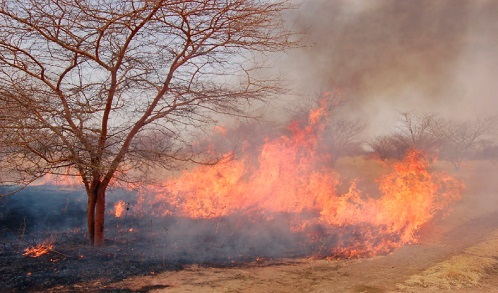
For longer than recorded history, fire has been a source of comfort but also a catastrophe for the human race.
Early humans used fire to keep warm, cook food and frighten predators. Sitting around the fire also helped them to unite and strengthen family groups and consequently speeded up evolution.
However, fire also posed great risks and challenges to early people, including the challenge of starting and controlling them, and grappling with the threat of burns and wildfires.
Fire continues to be a basic everyday element of most people’s lives. This tendency of one of man’s best friends to turn into his worst enemy cannot be underplayed, as improper handling and use of fire has led to several accidents in homes, offices, schools and other public places, with very serious repercussions.
Although it is the Ghana National Fire Service (GNFS) that is mandated to deal with fire outbreaks in the country, it is every citizen’s responsibility to ensure that fire is not even started at all.
We all use fire for different purposes, such as cooking, welding, fabricating, preparing land for farming, even refining, moulding metals and burning unwanted materials.
Fire is a good servant but a terrible master, the reason its usage is not left in the hands of children and why even adults ought to use it with utmost care to stop an outbreak from occurring.
The Daily Graphic’s analysis of the fire statistics revealed that the loss and damage occurred from 59,933 reported incidents of fire outbreaks from 2013 to 2022.( See our front page lead story)
The statistics further shows that 3,104 people died through fire-related incidents within the period, with 2,668 of such deaths occurring from road traffic crashes.
The trend analysis also indicated that more than GH¢402 million worth of public and private property have been lost to fire outbreaks in the country in the past 10 years, the GNFS statistics revealed.
The figure is less than the GH¢38.3 million worth of property that was salvaged by the GNFS within the same period.
Though staggering, the situation may just be a tip of the iceberg as Mr Osafo-Affum said most fire outbreaks went unreported and, therefore, were not recorded by the service.
Fortunately, as part of its mandate, the Ghana National Fire Service (GNFS) is working on a new regulatory regime that will make it mandatory for private residential accommodation owners to acquire a fire safety permit before they put up buildings.
The permit regime will ensure that residential accommodation owners incorporate fire safety mechanisms into the structure to make them safer for habitation.
The move is meant to reduce the rising incidence of domestic fires in the country. The current fire permit regime is limited to commercial property.
We of the Daily Graphic are happy to know that GNFS has started engagement with key stakeholders and experts on the initiative. The processes have started with the consultation of the various key stakeholders and per the implementation plan, we understand the permit will be rolled out in the next two years.
The Daily Graphic believes that the initiative by the GNFS to implement measures to curb domestic fire outbreaks is a step in the right direction, given that fire disasters were inimical to sustainable development.
Apart from avoiding a situation where another layer of bureaucracy will compound the current permit acquisition situation, implementing a fire permit regime for all persons seeking to put up private accommodation may only be effective in the urban areas of the country since the GNFS does not have the men to police enforcement.
We must all help the GNFS in the successful implementation of this noble initiative. After all, the success of GNFS is the success of all.
The Member of Parliament for North Tongu, Samuel Okudzeto Ablakwa, says the National Cathedral project will cost over GH¢1 billion and not the $400 million earlier projected by the government.
The legislator explained that the cost of compensations, demolition, tax waivers, consultancy, coupled with other stuff needed for the construction of the National Cathedral is estimated to cost GH¢1 billion.
Speaking toAbtvgh, Mr. Ablakwa bemoaned the waste of taxpayers’ money on the project.
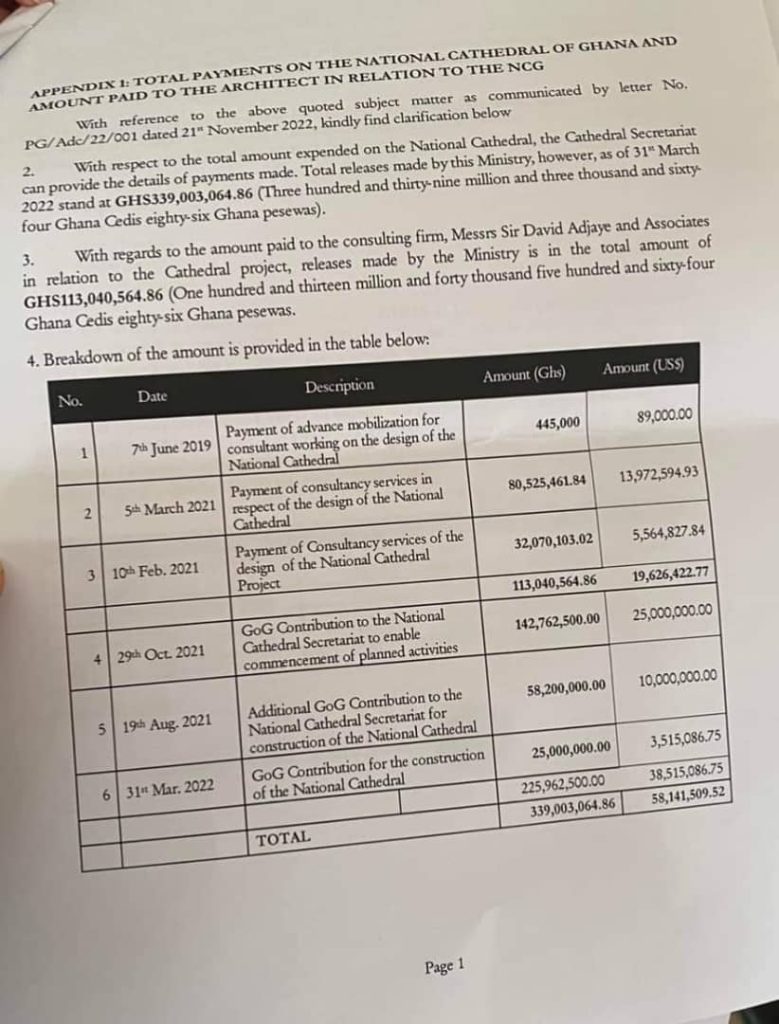
“The taxes are being misused, GH₵339,003,064.86 million cash withdrawn from the Consolidated Fund, but that is not all. My estimation is that billions will be used, because the cost of compensation, demolition, contracts escalations and all the tax waivers have not been added. So what’s going on here? The project will cost over GH₵1 billion and not the budgeted $400 million by the government,” the legislator emphasised.
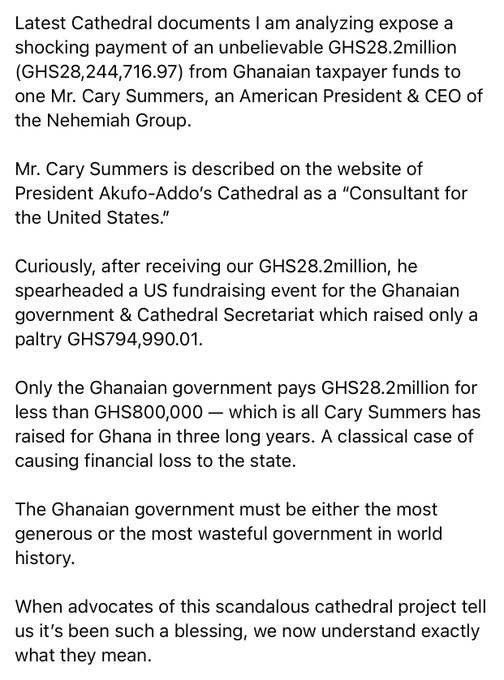
The MP for North Tongu pointed out that the government paid a whopping GH₵28.2 million to American consultant Cary Summers to coordinate the Bible Museum and the Biblical gardens for some artifacts for the Cathedral.
This, Mr. Ablakwa asked if the country is wealthy enough to dole out this huge sum of money to Cary Summers.
“In the latest revelation I made, GH₵28.2 million has been paid to one Cary Summers who is an American consultant. What’s the correlation with the Cathedral? Did Jesus Christ pass through the United States, because of this consultancy from the US, for the National Cathedral, we just hand over GH₵28.2 million to him. Can you believe that? Jesus Christ! Are we [Ghanaians] that wealthy that we don’t know what to do with our money? Are we under some curse?” Mr. Ablakwa asked.
However, the National Cathedral Secretariat in a statement said “with regard to the amount paid to the consulting firm, Messrs Sir David Adjaye and Associates in relation to the Cathedral project, release made by the Ministry is in the total amount of GH¢113,040,564.86”.
Read a portion of the National Secretariat’s statement
The National Cathedral Secretariat has denied making payments to the tune of GH¢28 million to Cary Summers, an American consultancy firm as charges to allegedly organize a fundraiser in the United States for the National Cathedral project.
The Member of Parliament for the North Tongu Constituency, Samuel Okudzeto Ablakwa, had accused the Secretariat of seeking the services of the firm that specializes in organizing Christian fundraisers to help it raise money to complete the project which subsequently led to the alleged payments.
The Secretariat was also accused of paying the architect for the project, Sir David Adjaye thirty-four percent of the total contract sum.
“The Akufo-Addo Govt & Cathedral Secretariat gave out a colossal GHS28.2million of taxpayer funds to Mr. Cary Summers, an American consultant & CEO of the Nehemiah Group who’s raised less than GHS800k in 3 years,” he posted on his Twitter handle.
More shocking revelations on the scandalous Cathedral project. The Akufo-Addo Govt & Cathedral Secretariat gave out a colossal GHS28.2million of taxpayer funds to Mr. Cary Summers, an American consultant & CEO of the Nehemiah Group who’s raised less than GHS800k in 3 years.
But the Secretariat in a six-point press release denied all the allegations.
To the accusation of paying Cary Summers GH¢28 million as consultancy fees, the Secretariat explained that: “there is no contract for Cary Summers, but rather the Nehemiah group—of which Cary Summers, the founding President of the Museum of the Bible in Washington DC, and one of the world’s leading experts on religious theme parks, is the CEO. And this contract is for a set of consultancy services, the most important being the coordination of work on the National Cathedral’s Bible Museum of Africa, and the Biblical Gardens of Africa. As we have indicated, the integration of the Bible Museum –the largest in the world when completed – and the Biblical Gardens are aimed at transforming Ghana into a hub for international pilgrimage and tourism.”
“The work of the National Cathedral’s Bible Museum and Biblical Gardens involves some of the leading global firms, who between them have worked on some of the major museums in the world. They include: Kubik Maltbie; PRD; Cortina Productions; JMC. The payments to the Nehemiah group, therefore, is not to Cary Summers to organize a fundraiser, but to these world-class firms for their work on the Bible Museum and Biblical Gardens.”
The Secretariat said there is neither anything sinister nor hidden about the said contract which is breeding the rumours because “the National Cathedral Secretariat submitted a copy of the report of the completed Concept Design of the Bible Museum and Biblical Gardens to Parliament on December 15, 2022. And we indicated to Parliament that the full concept design report, and all related documentation, is available upon request to the Secretariat.”
The release added that despite these rumours and many others, “the Board and Management of the National Cathedral Project remain focused and committed to the completion of the National Cathedral, and would continue to do so with diligence, integrity, excellence, and accountability.”
Read the full release below:
But the Secretariat in a six-point press release denied all the allegations.
To the accusation of paying Cary Summers GH¢28 million as consultancy fees, the Secretariat explained that: “there is no contract for Cary Summers, but rather the Nehemiah group—of which Cary Summers, the founding President of the Museum of the Bible in Washington DC, and one of the world’s leading experts on religious theme parks, is the CEO. And this contract is for a set of consultancy services, the most important being the coordination of work on the National Cathedral’s Bible Museum of Africa, and the Biblical Gardens of Africa. As we have indicated, the integration of the Bible Museum –the largest in the world when completed – and the Biblical Gardens are aimed at transforming Ghana into a hub for international pilgrimage and tourism.”
“The work of the National Cathedral’s Bible Museum and Biblical Gardens involves some of the leading global firms, who between them have worked on some of the major museums in the world. They include: Kubik Maltbie; PRD; Cortina Productions; JMC. The payments to the Nehemiah group, therefore, is not to Cary Summers to organize a fundraiser, but to these world-class firms for their work on the Bible Museum and Biblical Gardens.”
The Secretariat said there is neither anything sinister nor hidden about the said contract which is breeding the rumours because “the National Cathedral Secretariat submitted a copy of the report of the completed Concept Design of the Bible Museum and Biblical Gardens to Parliament on December 15, 2022. And we indicated to Parliament that the full concept design report, and all related documentation, is available upon request to the Secretariat.”
The release added that despite these rumours and many others, “the Board and Management of the National Cathedral Project remain focused and committed to the completion of the National Cathedral, and would continue to do so with diligence, integrity, excellence, and accountability.”